
AgeTech, as defined by the AgeTech Collaborative™ from AARP, is a category of technological solutions designed to meet the needs of the world’s aging population. These include products, services, and experiences across industries that aim to make the aging process easier, including, but not limited to, HealthTech, Mobility, Education, Communication, and Smart Home devices. While older adults, age 50-plus, have matched ownership of tech devices with those younger, and have increased their engagement with a variety of digital services, adoption of technologies specifically designed to support aging remains uneven. The question is why.
For older consumers, trust and privacy remain key barriers to tech adoption. Understanding what value they would get from the purchase is now an even bigger question as the category of options expand. In addition, it is crucial to understand that trust and privacy go beyond the fear of exposure of personal information; they also involve the fear of losing personal privacy.
Increasing adoption of AgeTech starts with a better understanding of the user and how the product or service is used in real life. Then, redefining the design based on feedback. It must be a human-centric design, one that is simple, intuitive, easy to navigate, and enjoyable to use, but also one that helps older adults maintain their dignity and privacy. It is important to include a diverse cohort of users age 50 and older who represent different life stages, backgrounds, and experience levels at these various points in the process. That includes initial market research, through testing and quality assurance. Finally, as it is introduced to the market, real-life applications and benefits must be clearly articulated. Only then will this audience invest the time, effort, and expense in these new technologies.
The next phase of AgeTech depends on applied human-centered insight, not additional technology capabilities. Understanding how people actually live, decide, adapt, and struggle is now essential.
The United States is entering a demographic and cultural inflection point. Older adults are living longer, exercising unprecedented economic influence, and redefining what later life should look like.
The longevity economy continues to expand, alongside rising expectations that aging can be lived with independence, dignity, and choice. Yet expectations are increasing faster than systems are adapting.
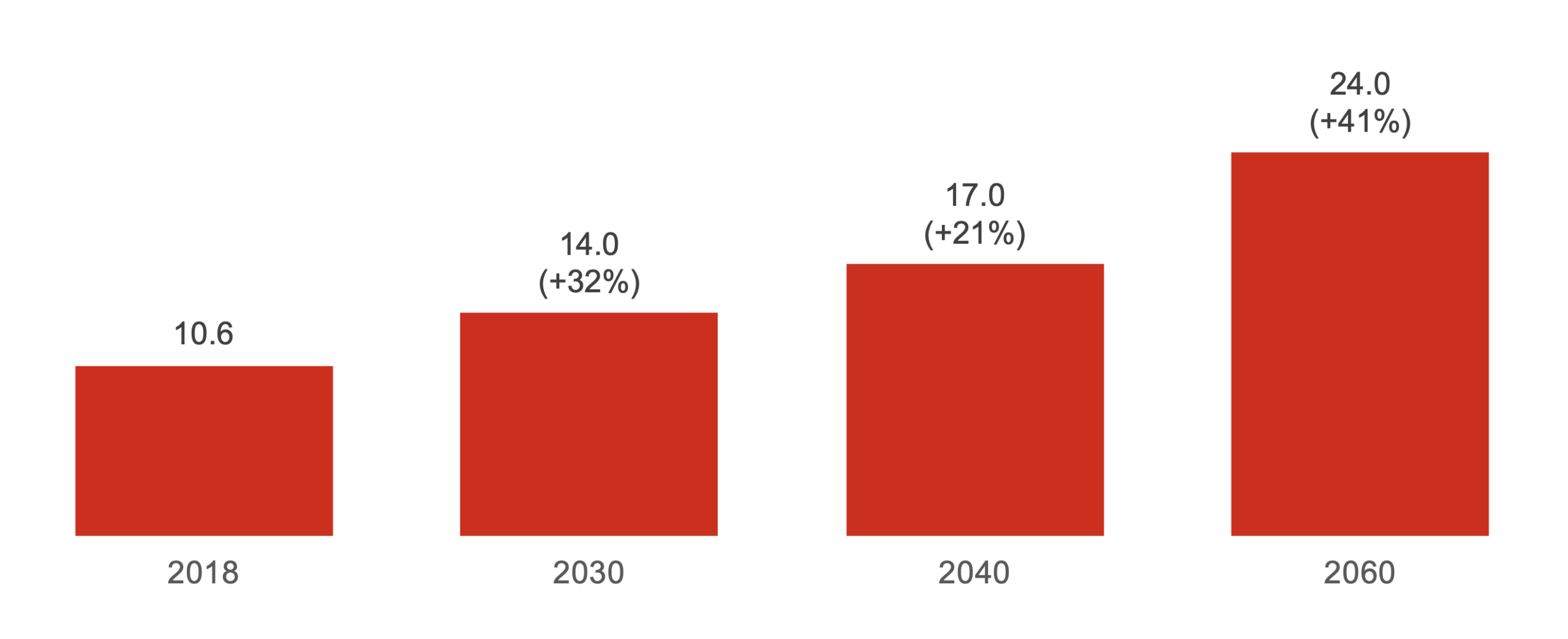
Contribution of the 50-plus population to U.S. GDP, 2018-2050
In $ trillion, percent growth in parentheses
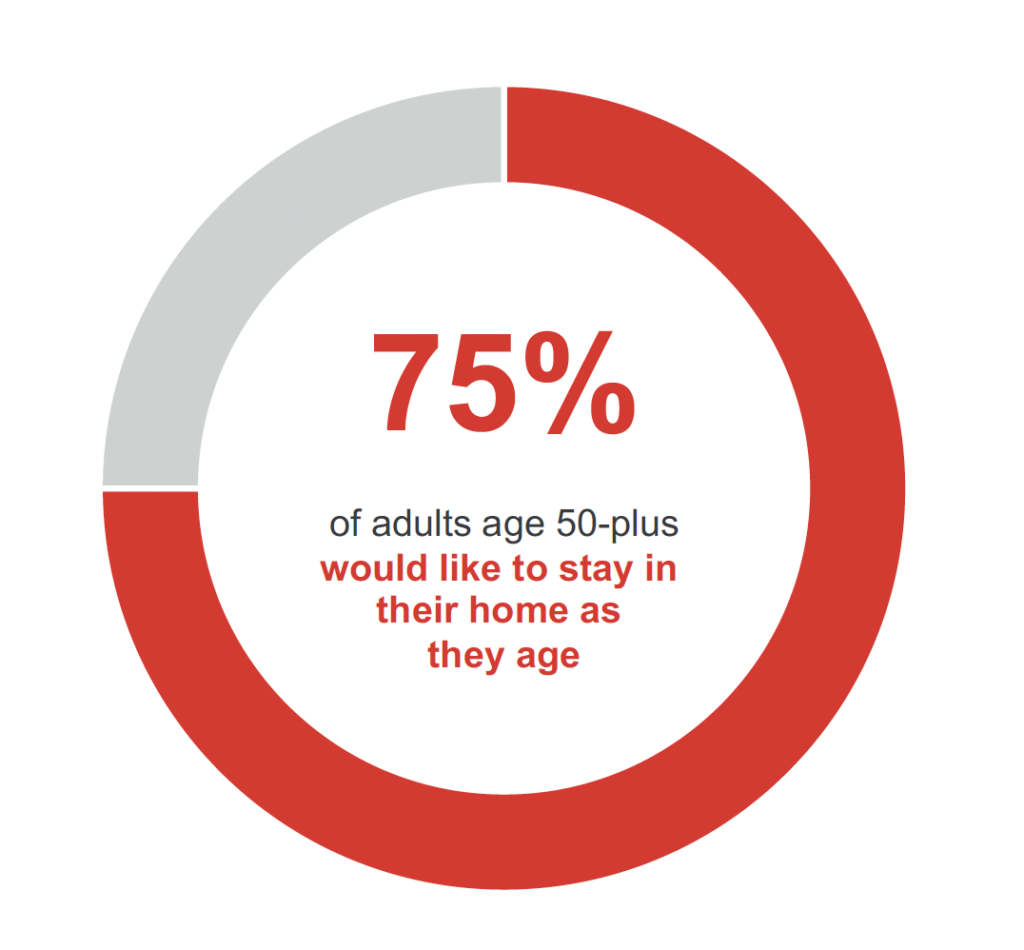
Most adults age 50-plus say they want to remain in their homes as they age (75%), and nearly as many (73%) want to stay in their communities. Aging in place is not a marginal preference; it is the dominant aspiration. However, nearly half (47%) lack confidence that their community will continue to meet their needs as they grow older. The desire to remain independent is strong, but confidence in the surrounding infrastructure is far less certain.
At the same time, caregiving responsibilities are shifting steadily from institutions to individuals and families. More than one in four adults age 50-plus (27%) provided unpaid care in the past year, signaling both the scale of informal caregiving and the increasing role of the home as a primary site of support.
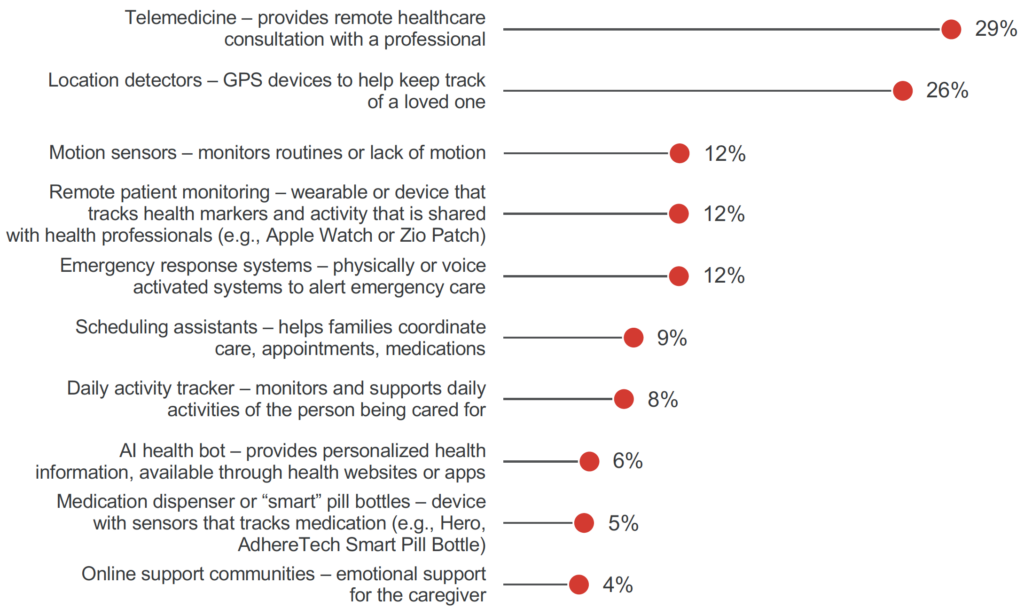
Technology is frequently positioned as a solution in this transition, promising coordination, monitoring, communication, and safety. Yet awareness and use of caregiver-focused technologies remain limited. As illustrated below, adoption across these tools peaks at roughly one-fourth of older adults and declines sharply across most categories, often falling to under 10%.
Percent who use the following caregiver technology
Among adults age 50-plus who have provided caregiving assistance
Meanwhile, technology overall is becoming embedded in daily life and, in many cases, is no longer optional. However, trust concerns, privacy considerations, and usability barriers continue to shape adoption decisions, particularly when technologies intersect with deeply personal aspects of health, autonomy, and independence.
Taken together, these consumer dynamics reveal not a lack of innovation, but a widening gap between aspiration and lived experience. Older adults expect to remain independent. Families are assuming greater responsibility for care. Technology is expanding in capability and availability. Yet confidence, alignment, and sustained engagement have not kept pace.
This is why this moment matters. Without applied insight grounded in how older adults actually live, decide, adapt, and struggle, AgeTech risks addressing theoretical problems rather than practical ones. Designing for real-world application, rather than technological possibility alone, is now essential to ensuring innovation translates into meaningful, sustained use.
Since 2015, more than $3 billion has been invested in AgeTech startups, with approximately half directed toward technologies, devices, and services designed specifically for older adults. These ventures aim to improve quality of life through health support, daily living assistance, and tools that promote safety and connection. Investment and innovation in this space have accelerated significantly. Yet, adoption and sustained engagement have not kept pace.
The gap often emerges not in the idea itself, but in its real-life application: how a product actually functions once it enters a home, a routine, and a relationship. Much of the AgeTech conversation has focused on what technology promises to enable older adults to do: live independently longer, manage complex health needs, remain safely at home, and maintain meaningful connections. Far less attention has been given to the experience of these tools in practice. That distance between promise and experience tends to appear in several consistent ways.
Many products never move beyond early adopters because they assume levels of skill, confidence, or trust that most users have not yet developed — promising tools stall before reaching the people who need them most.
Solutions built as stand-alone features ignore the reality that aging does not happen in a single domain. Health, housing, finance, and social connection are interdependent, and technology that treats them as separate problems reflects a fundamental misreading of the layered, cross-sector architecture that aging actually requires.
Even well-designed products often fail in practice because they were built for ideal conditions rather than real care environments, where sensory changes, fatigue, and emotional context reshape how a tool is used moment to moment. This gap is compounded in caregiving when the caregiver is treated as invisible. Older adults and their caregivers frequently function as a dual-user system. Yet, most AgeTech is designed for only one of them, creating friction, missed handoffs, and technology that no one ends up owning.
When products are designed from the outside in, built on assumptions about what aging looks like rather than grounded in how older adults actually make decisions, build trust, and integrate new tools into their daily lives, the research and design process loses its footing before it begins. The result is technology that is technically functional, but practically abandoned.
Even when a product works, getting it into the hands of the people who need it is a challenge in its own right. The path to scale is often blocked by how the system is set up: who pays for it, how it gets approved, and whether organizations or institutions are willing to change the way they have always done things. The tools that win are not necessarily the best ones. They are the ones that fit most easily into existing budgets, insurance approvals, and billing structures. Getting a great product to market is only half the battle. The other half is navigating a system that was not built with innovation in mind.
These challenges are rarely technical failures. Most AgeTech falls short not because of the technology itself, but because it misunderstands incentives, distribution, trust, and the lived complexity of aging.
Compounding this is consumer perception. Most older adults do not believe technology is designed with their age in mind. Feeling unseen in the design process creates significant adoption hesitation, even for technology that is meant to improve the quality of life specifically.
Bridging these gaps requires more than refinement after launch. It needs grounding in innovation in how older adults live, make decisions, weigh tradeoffs, and adapt over time. Human-centered insight, a genuine understanding of people’s unique experiences, is now the differentiator in AgeTech.
Applied AgeTech begins with a simple, but often overlooked premise: technology does not live in a vacuum; it lives in people’s homes, routines, and relationships. It must account for the real decisions older adults face each day: whether to adopt a new device, share personal data, adjust long-standing habits, or trust a system to perform reliably. It must fit within everyday contexts that are often complex, emotionally charged, and shaped by decades of routine.
Applied AgeTech refers to the application of technology, designed specifically to meet needs of real people – not just the ideal or stereotypes of older adults.
Designing for this reality requires more than functionality. It requires understanding the tradeoffs and emotional drivers that influence trust, adoption, and follow-through. It demands attention to the minor friction points – the extra step, the unclear instruction, the moment of doubt that ultimately determines whether a tool becomes integrated into daily life or quietly set aside.
This is where human stories come in; they are not just anecdotes; they are evidence of the truth. They illuminate where systems align with real behavior, where they create strain, and where they fail.
Applied AgeTech insists that these insights are not post-launch learnings but foundational inputs that must shape technology from the earliest stages of design.
With nearly 50% of companies entering the AgeTech market pure business-to-consumer focused, there is no time like the present for adopting applied AgeTech practices. This benefits the company and the individual, ensuring the end user is part of the conversation before tech, devices, or services aimed at helping them are rolled out.
Applied AgeTech requires a fundamentally different way of thinking about aging.
Too often, “old” or “older” is defined as a single 50-plus category and framed through stereotypes of vulnerability, decline, and limitation. This narrow view not only alienates older adults, but it also leads designers and brands to overlook a critical reality: needs do not change simply because of age, but because of where people are in their personal journey of independence, health, and support.
In real life, people move through different stages of independence over time, often unevenly and at their own pace. Effective AgeTech solutions acknowledge this progression by being flexible, adaptive, and respectful of autonomy and dignity as needs evolve. Designing for a static age group misses the lived experience of aging, where change is gradual, contextual, and deeply personal.
To better reflect this reality, AARP reframes aging as a progression of needs rather than a single category. This cohort-based approach outlines three phases of the aging journey: Active, Supported, and Assisted, each defined not by age alone, but by differing levels of independence, health focus, and the types of technologies that can most meaningfully support people at that stage.
Active consumers are tech-savvy and forward-thinking. They are aware of aging and focused on prevention, wellness and planning.
Active older adults are primarily oriented toward staying well and planning ahead. Their needs center on preventive health and maintaining momentum in everyday life, with a need for tools that help them monitor and act on health insights without disrupting routine.
Supported older adults recognize changes in health and mobility and are seeking ways to maintain their independence and social connections.
Supported older adults often navigate noticeable changes in health, including living with two or more conditions as health declines. They are focused on maintaining independence as their needs increase and require solutions that reduce friction, burden, and uncertainty in everyday life.
As personal responsibilities lessen, assisted older consumers focus on aging in place with comfort and dignity – and on minimizing the burden on loved ones.
Assisted older adults are characterized by greater dependence on continuous care, whether from family or paid caregivers, for daily needs such as nutrition, personal hygiene, and wellness. In this stage, Applied AgeTech is most effective when it supports consistent routines and care coordination while reinforcing comfort and dignity as needs evolve.
Older adults are not monoliths. They are diverse in terms of mindset, ability, and needs across the aging journey. Together, the Active, Supported, and Assisted cohorts capture distinct patterns of independence, health priorities, and support needs across the aging journey. By framing aging as a progression of needs, this approach shifts the focus from chronological age to designing responsive supports that evolve over time. It is important to note that people move across these states, often in non-linear ways. Therefore, effective AgeTech must adapt with them.
AARP and the AgeTech Collaborative will be publishing a three-part series that translates lived experiences with tech into practical insights. The focus of each publication is to help designers better understand how people actually live, decide, adapt, and struggle, and where specific types of technology can truly make an impact, and where it might currently be falling short.
Within each publication, personal stories and quotes will shine a light on real-life decision-making moments, experiences, and lived realities of older adults. The goal of the series is to fill in the missing dialogue, explore how real life gets in the way of good tech ideas, and give a voice to still-unmet needs.
The key learning from each publication will be the clear implications for design, innovation, and the application of the technology across the categories covered. Some will be at a high level, with a universal takeaway; some will be tech-specific. In either case, it will provide a piece of the design framework that is often missing – how the tech is actually received and used, or not.
Below is an overview of the AgeTech categories to be explored and analyzed.
Aging in Place
How older adults decide whether staying in their home as they age is possible, safe, and desirable, and what pushes them to adapt or move.
AI and Independence
How older adults are actively seeking out artificial intelligence (AI) to support their independence, and where the technology falls short in design, trust, and usability before it can deliver on what people actually need it to do.
Caregiver Tech & Advanced Care at Home
How informal caregivers navigate burden, coordination, trust, and monitoring when complex care moves into the home environment.
This series is designed not only to inform, but to influence action across the AgeTech ecosystem.
There are three key audiences this series is aimed at assisting:
By 2050, more than a third of the global population will be over age 50. The U.S. is also aging rapidly; by 2030, 21% of Americans will be at least 65 years old.
AgeTech is a critical technology category and will only become more important over the next few years, as 10,000 people turn 65 in the United States every day, many of whom are expected to live until 100.
But AgeTech can no longer rest solely upon what the technology can do; it must apply to real life. Applied AgeTech is no longer optional; it is foundational.
Growth in this category will be defined by 1) what people trust – the technology and the brand, 2) what fits easily into their daily lives, 3) what can adapt as their needs change, and 4) which ones preserve dignity throughout the aging journey.
The next phase of AgeTech depends on applied human-centered insight, not additional technology capabilities. Understanding how people actually live, decide, adapt, and struggle is now essential.